 Clearwater Window
 Why Decks in Safety Harbor Wear Out Faster Than the National Average
Safety Harbor sits right on Old Tampa Bay, which means every deck here is doing double duty: holding up a household and standing up to a coastal microclimate that's harder on wood, fasteners, and finishes than almost anywhere inland. Between the hurricane-force winds that can move through Pinellas County in a given storm season, the near-constant UV exposure of a Florida summer, wind-driven rain that gets pushed sideways under railings and against ledger boards, and a steady drift of salt air off the bay, a deck built to a generic national standard often shows real wear years before a homeowner expects it.
That combination is why we treat deck replacement here as a climate-specific job, not a one-size-fits-all product install. The framing, fasteners, decking material, and even the orientation of the boards all get chosen with Safety Harbor's conditions in mind, not just what looks good in a showroom.
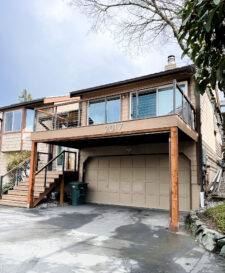
Signs Your Deck Needs Replacement, Not Just Repair
Not every tired-looking deck needs to come out. But there's a point where patching boards or re-staining stops being worth it, and pushing past that point usually means paying for a repair that fails again within a season or two. Here's how we tell the difference on a Safety Harbor inspection.
Structural red flags
- Soft, spongy, or spalling wood at the ledger board where the deck meets the house — a common failure point where wind-driven rain collects
- Rusted, corroded, or backed-out fasteners, especially on decks more than 10-12 years old near the water
- Visible sag between joists, or noticeable bounce when walking across the deck
- Posts or footings that have shifted, cracked, or show rot at the base
- Railings that flex or feel loose when pushed — a safety issue, not just a cosmetic one
When repair still makes sense
If the frame is sound and the issues are limited to a handful of surface boards, sun-faded finish, or a railing section that took storm damage, targeted repair can be the more honest recommendation. We'll tell you that on the estimate — replacement isn't the answer to every problem, and a good contractor says so even when it means a smaller job.
What a Correct Deck Replacement Actually Involves
Inspection and scope
Before any demo, we check the ledger connection, the condition of the support posts and footings, and the framing underneath the visible boards. In coastal Pinellas County, the substructure often has more hidden deterioration than the decking on top, since that's what takes the brunt of trapped moisture and salt exposure. We won't quote a full decking replacement over a compromised frame — that just moves the failure point down the road.
Permitting
Deck replacement in Safety Harbor and unincorporated Pinellas County generally requires a building permit, particularly when structural framing, footings, or railings are involved. Permitted work gets inspected, which is exactly what you want on a structure people stand on. We handle the permit application and coordinate the required inspections as part of the job — it's not an upsell, it's how the work gets done correctly.
Demolition and structural rebuild
Old decking, railings, and any compromised framing come out first. We evaluate ledger flashing, post connections, and joist hangers against current code, since a lot of older Florida decks were built before wind-load and hurricane-tie requirements tightened up. Any undersized or corroded hardware gets upgraded, not just reused.
Decking, railing, and fastening
Boards go down with fasteners and hardware rated for coastal exposure — this is one of the places cutting corners shows up fastest in a salt-air environment. Railings are set to current code height and baluster spacing, and every ledger connection is properly flashed to keep wind-driven rain from re-entering the wall assembly.
Final walkthrough
We walk the finished deck with you, check for level, check every railing and stair connection by hand, and go over care instructions specific to the material you chose. You get a deck you understand, not just one you were handed a key to.
Choosing a Decking Material for Safety Harbor's Climate
There's no universally "best" decking material — there's a best fit for your budget, your maintenance appetite, and how much punishment your specific lot takes from sun and salt. Here's how the common options actually perform in this climate.
| Material | UV / Sun Performance | Salt Air Resistance | Maintenance | Typical Lifespan Here |
|---|---|---|---|---|
| Pressure-treated pine | Fades and grays without regular finish | Fair — needs sealant to resist salt-driven checking | Annual cleaning, re-stain every 1-2 years | 10-15 years |
| Composite decking | Good — fade-resistant formulations hold color | Good with capped boards; uncapped composite can absorb moisture near the bay | Low — periodic washing, no staining | 20-25+ years |
| PVC / cellular PVC | Excellent — engineered specifically for UV stability | Excellent — doesn't absorb moisture or salt | Lowest — soap and water | 25-30+ years |
| Tropical hardwood (e.g., ipe) | Very good if oiled; grays naturally if left bare | Very good — naturally dense and rot-resistant | Moderate — periodic oiling for color retention | 25+ years |
We install a range of these depending on the homeowner's priorities. Our general standard is to steer people toward capped composite or PVC for decks with significant bay exposure or full-sun orientation, simply because the maintenance burden and moisture behavior of uncapped or lower-grade boards tend to disappoint owners within a few years in this specific climate — not because any one product is bad everywhere, just that Safety Harbor's sun and salt are unusually demanding.
Framing and fastener choices matter as much as the decking
A beautiful composite deck on undersized or corroded framing is still a bad deck. We spec pressure-treated or engineered framing lumber appropriate for ground contact and coastal exposure, and we use stainless steel or coated fasteners rated for the environment rather than standard hardware that can start rusting and staining boards within a year or two near saltwater.
Permitting and Code Considerations Specific to This Area
Because Safety Harbor is exposed to the wind loads that come with sitting on the bay, deck framing and railing connections here need to meet Florida Building Code wind-resistance requirements, which are meaningfully stricter than a lot of homeowners expect if they've had decks built or replaced in other states. That means hurricane ties at key connections, ledger attachment methods engineered for uplift and lateral load, and railing systems that won't loosen under wind pressure over time. If your property has HOA guidelines, we also account for those on the design side before permitting, so there's no surprise mid-project.
What Drives the Cost of a Deck Replacement
Every deck is different, so we don't quote off a square-footage formula alone — but these are the factors that move the number up or down on most Safety Harbor projects:
- Size and footprint — larger decks and multi-level designs cost more in both material and labor
- Decking material — pressure-treated is the lowest upfront cost; PVC and premium composite run higher but reduce long-term maintenance spending
- Substructure condition — if posts, footings, or framing need rebuilding rather than reuse, that adds scope beyond surface decking
- Railing system — wood, aluminum, and cable railings all price differently, and code-required height and spacing affect material quantity
- Height and stairs — elevated decks with multiple stair runs require more structural work than a single-level, ground-hugging deck
- Permitting complexity — larger structural changes mean more inspection steps built into the timeline
- Site access — decks with tight side-yard access or waterfront setbacks can add labor time for material staging and demo removal
We'll walk through each of these on-site so the estimate reflects your actual deck, not a generic average.
Caring for a New Deck in a Coastal Climate
Whatever material you choose, a few habits go a long way in Safety Harbor's specific conditions:
- Rinse salt residue and pollen off the deck surface periodically, especially after storms with onshore wind
- Check railing and stair fasteners once or twice a year for early signs of corrosion, even with coastal-rated hardware
- Keep gutters and downspouts clear so runoff isn't dumping extra water onto the deck surface or ledger connection
- For wood or uncapped composite, follow the manufacturer's recommended cleaning and refinishing schedule rather than waiting until fading is obvious
- Trim back vegetation that traps moisture against framing or railing posts
None of this is complicated, but skipping it is exactly how a well-built deck ends up needing early repairs in a climate this demanding.
Why It Matters That We Already Work in Safety Harbor
A contractor who mostly builds inland or out of state doesn't think about ledger flashing the same way, doesn't spec fasteners for salt exposure by default, and may not know Pinellas County's permitting process off the top of their head. Working this area regularly means we've already seen how decks built to a generic spec hold up here — and where they don't. That local pattern recognition is what keeps a replacement from becoming a repeat job in five years instead of twenty-five.
Get a Free, No-Pressure Estimate
If your deck is showing its age or you're planning a new one for a Safety Harbor property, we're happy to come take a look, walk the structure with you, and give you an honest read on repair versus replacement. There's no obligation and no pressure — just a straightforward estimate from a crew that already knows what this climate does to a deck. The form below gets you started.